Spinal Decompression Therapy
Advanced Cervical & Lumbar Traction with the Chattanooga Triton DTS® System
Back pain, neck pain, disc-related symptoms, and radiating pain can interfere with work, sleep, exercise, and everyday life.
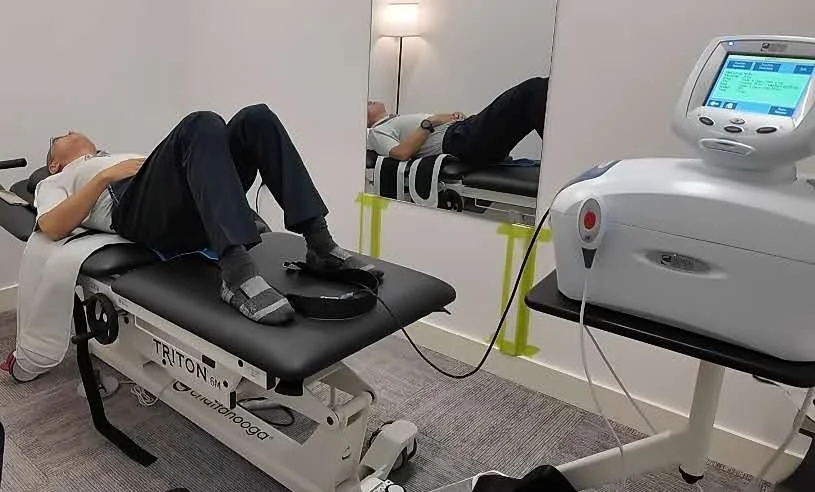
At ProSpine Rehab & Wellness in Vancouver, we provide individualized spinal decompression and mechanical traction using the Chattanooga Triton DTS® system and Triton 6E traction table.
The Triton DTS system allows controlled cervical or lumbar traction to be customized according to the patient's condition, comfort, and response to treatment. It can provide static, intermittent, or cyclic traction patterns rather than simply applying one constant pulling force.
BOOK A SPINAL DECOMPRESSION ASSESSMENT
What Is Spinal Decompression Therapy?
Spinal decompression is a form of non-surgical mechanical traction.
During treatment, a controlled traction force is applied to the cervical or lumbar spine while you lie comfortably on a specialized treatment table.
The goal is to gently distract spinal structures and modify mechanical loading around joints, discs, and irritated nerve roots.
Unlike a simple stretching table, the Triton DTS system can be programmed with different:
Pull forces • Hold times • Rest periods • Traction patterns • Treatment durations
This gives the clinician more control over how treatment is delivered.
Our Triton DTS® 6E System
Advanced Technology. Personalized Treatment.
ProSpine uses the Chattanooga Triton 6E, a six-section powered traction table designed specifically for manual and traction therapy.
The table provides multiple positioning options for both lumbar and cervical treatment and can accommodate prone or supine positioning.
The Triton 6E includes electrically adjustable sections that allow the clinician to modify positioning of the head, chest, pelvis, and legs. Its pelvic section can also be adjusted to alter lumbar positioning during treatment.
When paired with the Triton DTS traction unit, the system provides programmable static, intermittent, and cyclic traction.
Why this matters
Spinal problems do not all respond to exactly the same position or traction force.
The Triton DTS system allows us to adjust treatment according to factors such as:
Your symptoms
The area being treated
Your tolerance
Your examination findings
Whether symptoms are localized or radiating
Your response during previous sessions
Your treatment is therefore individualized rather than based on one preset program.
Conditions We May Consider for Spinal Decompression
Spinal decompression is not appropriate for every patient, but after an assessment it may be considered for certain cervical or lumbar musculoskeletal conditions.
These may include:
Herniated or Bulging Discs
Disc-related irritation may produce localized back or neck pain and, in some cases, symptoms travelling into an arm or leg.
Mechanical traction may be considered as one component of conservative management for selected patients.
Sciatica & Lumbar Radiculopathy
Sciatica commonly describes pain or neurological symptoms travelling from the lower back or buttock into the leg.
Research suggests that mechanical traction may provide short-term benefit for some patients with lumbar radiculopathy, although results vary and traction should not be considered universally effective for all low-back pain.
Cervical Radiculopathy
Irritation of a nerve root in the neck may cause neck pain along with symptoms travelling into the shoulder, arm, or hand.
Traction is sometimes incorporated into conservative rehabilitation for cervical radiculopathy. Research has shown potential benefit in some patients when traction is combined with other treatment, although the strength and clinical importance of the evidence varies between studies.
Degenerative Disc & Joint Changes
Age-related changes can sometimes contribute to stiffness, restricted movement, or nerve irritation.
Treatment is based on symptoms and examination findings rather than imaging findings alone.
Spinal Joint Stiffness
Some patients may experience restricted spinal movement or discomfort that responds to a combination of traction, manual therapy, mobility work, and rehabilitation.
Lumbar Spinal Decompression
For Low Back & Leg Symptoms
For lumbar treatment, you are positioned comfortably on the Triton table and secured using specialized traction belts.
The traction unit then applies a controlled force according to parameters selected by your clinician.
Treatment may be performed in different lumbar positions depending on your presentation.
Patients considered for lumbar traction may have concerns such as:
Low back pain • Disc-related symptoms • Sciatica • Leg pain • Nerve irritation • Lumbar stiffness
The treatment should feel like a controlled stretch or pulling sensation rather than an aggressive manipulation.
Cervical Spinal Decompression
For Neck, Shoulder & Arm Symptoms
The Triton DTS system can also be configured for cervical traction.
This allows controlled traction to the neck while you remain supported in a comfortable position.
Cervical traction may sometimes be considered when symptoms involve:
Neck pain
Cervical disc-related conditions
Arm pain
Cervical radiculopathy
Tingling or numbness related to nerve irritation
Restricted cervical movement
The amount of traction is adjusted according to your symptoms and tolerance.
Is Spinal Decompression the Same as Chiropractic Adjustment?
No.
A chiropractic adjustment involves a brief manual force directed toward a joint.
Spinal decompression uses a slower, controlled mechanical traction force over a period of time.
For some patients, the two may be used together as part of a broader treatment plan.
For others, decompression may be used without manual adjustment.
Your treatment plan depends on your assessment and preferences.
What Does a Treatment Feel Like?
Most patients remain fully clothed during spinal decompression treatment.
You lie on the Triton table while positioning and traction parameters are set.
During lumbar decompression, specialized belts help stabilize the upper body and pelvis while the machine applies the programmed traction force.
Patients commonly describe the sensation as a gentle, progressive stretch.
You should communicate with your clinician throughout treatment. If the traction produces increased or concerning symptoms, the treatment can be modified or stopped.
What Happens at Your First Appointment?
1. Consultation
We begin by discussing your symptoms, health history, previous treatment, activity level, and goals.
If you have previous MRI, CT, or X-ray reports, please bring them with you.
2. Physical & Neurological Assessment
Depending on your symptoms, your chiropractor may assess:
Range of motion • Joint function • Muscle strength • Reflexes • Sensation • Orthopedic testing • Nerve tension
3. Imaging When Appropriate
Not every patient requires imaging.
However, ProSpine has access to in-house digital X-ray when clinically indicated.
MRI or other imaging may sometimes be recommended when additional information is required.
4. Determine Whether Decompression Is Appropriate
Spinal decompression is not automatically recommended simply because someone has back or neck pain.
Your chiropractor first determines whether your clinical presentation appears suitable for traction therapy.
5. Personalized Treatment Parameters
If decompression is appropriate, we select treatment parameters based on your condition and tolerance.
These may be adjusted throughout your course of care depending on your response.
How Many Sessions Will I Need?
There is no single number of treatments that is appropriate for every patient.
Frequency depends on factors such as:
Diagnosis • Severity • Duration of symptoms • Neurological findings • Response to treatment • Activity demands
Some patients may receive decompression as part of a short period of conservative care, while others with longer-standing conditions may require a longer rehabilitation program.
We reassess your progress rather than assuming every patient requires the same number of sessions.
Decompression Works Best as Part of a Complete Plan
At ProSpine, we do not view decompression as a stand-alone cure.
When appropriate, your program may also include:
Chiropractic Care
To address joint mobility and other mechanical findings.
Active Rehabilitation
Exercises may help restore strength, stability, mobility, and confidence with movement.
Mobility & Stretching
Specific exercises may be prescribed according to your condition.
Activity Modification
We may help identify work, exercise, lifting, or sitting habits that aggravate your symptoms.
Progressive Return to Activity
The ultimate goal is to help you return to the activities that matter to you rather than remain dependent on passive treatment.
Is Spinal Decompression Safe?
Mechanical traction has been used in rehabilitation for many years, but appropriate patient selection is important.
Before recommending decompression, we screen for conditions that may make traction inappropriate or require additional medical evaluation.
Traction may not be suitable for certain patients, including some people with significant spinal instability, certain fractures, serious neurological conditions, infections, malignancy, or other medical conditions.
Your health history and examination determine whether treatment is appropriate.
Does Spinal Decompression “Put the Disc Back In”?
This is an important distinction.
You may see websites claiming that decompression permanently “sucks a disc back into place” or guarantees disc healing.
We do not make those claims.
Mechanical traction changes loading and movement of the spine during treatment and may help selected patients with certain pain or radicular presentations. Research supports potential benefits for some patients, particularly in specific radicular conditions, but response varies and it is not a guaranteed treatment.
Our recommendation is based on your clinical presentation and how you respond to care.
Why ProSpine for Spinal Decompression?
Advanced Chattanooga Triton DTS® Technology
We use a dedicated professional traction system rather than a basic inversion or stretching table.
Cervical & Lumbar Treatment
The system can be configured for both neck and lower-back traction.
Individualized Parameters
Force, positioning, timing, and traction patterns can be modified for each patient.
In-House Digital X-Ray
When clinically indicated, imaging is available directly within our clinic.
Chiropractic + Rehabilitation
Decompression can be incorporated into a broader program focused on mobility, strength, and function.
Progress-Based Care
Your treatment recommendations are modified according to your response rather than following the same protocol for every patient.
Frequently Asked Questions
Is spinal decompression painful?
Treatment should generally feel like a controlled stretch rather than a painful procedure.
If symptoms worsen during treatment, tell your clinician immediately so the treatment can be modified or stopped.
Do I stay dressed?
Yes. Patients normally remain fully clothed.
Comfortable clothing is recommended.
Can decompression help a herniated disc?
Mechanical traction may be considered as part of conservative care for certain patients with disc-related or radicular symptoms. Whether it is appropriate depends on your symptoms and examination.
Do I need an MRI first?
Not necessarily.
Imaging is recommended only when clinically indicated based on your history, examination, and symptoms.
Can I exercise while receiving decompression?
Often yes, and rehabilitation is commonly an important part of care. Your activity recommendations depend on your individual condition.
Is this the same as an inversion table?
No.
The Triton DTS system allows a clinician to control the traction force, timing, positioning, and treatment pattern much more precisely than simply hanging or inverting the body.
Find Out Whether Spinal Decompression Is Right for You
If you're dealing with persistent back pain, neck pain, sciatica, or radiating arm or leg symptoms, the first step is determining what may be causing the problem.
At ProSpine Rehab & Wellness, we can assess your condition and determine whether Triton DTS spinal decompression should be part of your treatment plan.
ProSpine Rehab & Wellness
Vancouver, BC
778-805-8188
info@prospinevan.ca
BOOK A SPINAL DECOMPRESSION ASSESSMENT