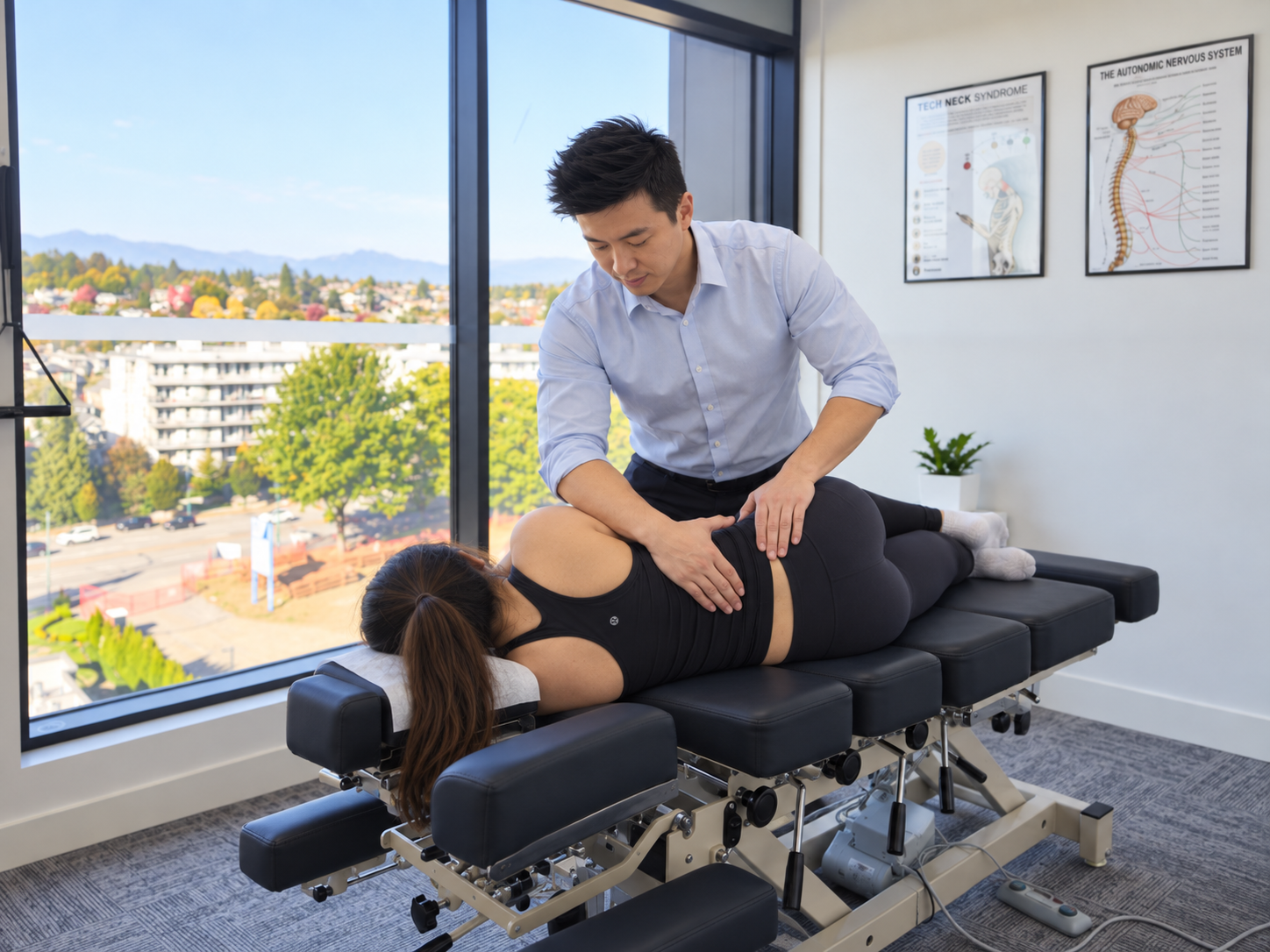
Lower Back Pain Treatment
Personalized Chiropractic & Rehabilitation Care for Lower Back Pain

Low back pain can interfere with sitting, standing, lifting, working, exercising, sleeping, and everyday activities.
At ProSpine Rehab & Wellness in Vancouver, we assess what may be contributing to your lower back pain and create an individualized treatment plan based on your symptoms, movement, activity level, work demands, and goals.
Depending on your condition, care may include chiropractic treatment, joint mobilization, soft-tissue techniques, spinal decompression, mobility work, and active rehabilitation with our on-site kinesiologist.
BOOK A LOW BACK PAIN ASSESSMENT
Low Back Pain Is Common — But Not All Back Pain Is the Same
Lower back pain can develop suddenly after lifting, exercise, or an injury, or it may build gradually over time.
Some patients experience a localized ache. Others notice stiffness, sharp pain with movement, or symptoms that travel into the buttock or leg.
Common contributors may include:
Muscle or ligament strain
Joint irritation or stiffness
Disc-related conditions
Facet joint irritation
Sacroiliac joint dysfunction
Prolonged sitting
Repetitive lifting
Sports injuries
Motor vehicle accidents
Reduced hip mobility
Deconditioning
Nerve irritation
The first step is determining which factors may be most relevant to your symptoms.
What Does Low Back Pain Feel Like?
Low back pain can present in many different ways.
You may experience:
A dull ache
Sharp pain with bending or twisting
Stiffness after sitting
Pain when standing from a chair
Discomfort with lifting
Muscle tightness
Pain after prolonged standing
Buttock discomfort
Reduced range of motion
Pain that worsens during exercise
Difficulty finding a comfortable sleeping position
If symptoms travel into the leg or are accompanied by numbness or tingling, a nerve may also be involved.
Common Causes of Lower Back Pain
Muscle & Soft-Tissue Strain
Lifting, repetitive activity, sudden movement, or exercise can irritate muscles and surrounding tissues.
Lumbar Joint Stiffness
Restricted or irritated joints in the lower back may make bending, twisting, or prolonged positions uncomfortable.
Disc-Related Pain
Spinal discs may become irritated or, in some cases, contribute to nerve-related symptoms.
Facet Joint Pain
Facet joints are small joints at the back of the spine that may become irritated with repeated loading, extension, or rotation.
[LEARN MORE ABOUT FACET JOINT PAIN]
Sacroiliac Joint Dysfunction
Pain arising around the SI joint is often felt lower and more toward one side of the pelvis or buttock.
[LEARN MORE ABOUT SI JOINT DYSFUNCTION]
Sciatica & Lumbar Radiculopathy
If a lumbar nerve becomes irritated, symptoms may travel into the buttock, thigh, calf, foot, or toes.
[LEARN MORE ABOUT SCIATICA]
How We Assess Low Back Pain
Your first appointment begins with a detailed discussion about your symptoms.
We may ask:
When did the pain begin?
What movements make it worse?
Does sitting aggravate it?
Does pain travel into the leg?
Have you noticed numbness or weakness?
What kind of work do you do?
What sports or exercises do you participate in?
Have you had previous injuries?
Your chiropractor may then assess:
Spinal range of motion • Joint mobility • Hip movement • Strength • Reflexes • Sensation • Orthopedic tests • Neurological function • Functional movement
The goal is to determine whether conservative care is appropriate and which treatment options may be useful.
Chiropractic Care for Low Back Pain
For selected patients with musculoskeletal low back pain, chiropractic care may be part of a conservative treatment plan.
Care may include:
Chiropractic Adjustments
Controlled spinal or pelvic adjustments may be used when clinically appropriate to improve joint movement.
Joint Mobilization
Gentler mobilization techniques may be used depending on your comfort and condition.
Soft-Tissue Treatment
Muscles around the lower back, hips, and pelvis may become tight or guarded.
Mobility Exercises
Exercises may focus on spinal, hip, or pelvic movement depending on your findings.
Treatment is individualized rather than based on one standard technique.
Spinal Decompression for Selected Patients
For certain patients with disc-related or nerve-related symptoms, mechanical spinal decompression may be considered.
At ProSpine, we use the Chattanooga Triton DTS® traction system with the Triton 6E table.
Treatment parameters can be adjusted according to:
Force • Position • Hold time • Rest time • Treatment duration • Patient tolerance
Spinal decompression is not appropriate for every person with back pain, so we first assess whether it may be suitable for your condition.
[LEARN MORE ABOUT SPINAL DECOMPRESSION]
Active Rehabilitation With Our Kinesiologist
Pain relief is only one part of recovery.
Once appropriate, active rehabilitation can help rebuild strength, movement, and confidence.
Our on-site kinesiologist may help you work on:
Core strength
Hip and glute strength
Spinal mobility
Balance
Movement control
Lifting mechanics
Gradual loading
Return to exercise
Return to work or sport
This allows chiropractic care and rehabilitation to work together within the same clinic.
Our goal is to progress from:
Reducing irritation → restoring movement → building strength → returning to activity
Low Back Pain From Sitting
Prolonged sitting can aggravate some types of lower back pain.
Rather than trying to hold one “perfect” posture all day, we often encourage:
Regular position changes
Short walking breaks
Standing periodically
Workstation adjustments
Appropriate mobility exercises
Gradual improvement in sitting tolerance
The goal is to help your body tolerate everyday positions more comfortably.
Low Back Pain From Lifting
Lifting-related pain can occur at work, in the gym, or during everyday activities.
Rehabilitation may include:
Hip hinge mechanics • Core control • Glute strength • Gradual loading • Functional lifting practice
The long-term goal is not simply to avoid lifting, but to help you return to it safely when appropriate.
Low Back Pain in Athletes
Sports such as golf, running, weight training, martial arts, hockey, and racquet sports can place repeated demands on the lower back.
A sports-focused assessment may look at:
Spinal mobility • Hip movement • Strength • Core control • Training load • Sport-specific movement
Treatment and rehabilitation can then be tailored to your activity.
[LEARN MORE ABOUT SPORTS CHIROPRACTIC]
Do I Need an X-Ray or MRI?
Not every case of low back pain requires imaging.
At ProSpine Rehab & Wellness, we have access to in-house digital X-ray imaging when clinically indicated.
X-rays can help evaluate certain bony and structural findings, but they do not directly show discs or nerves.
An MRI may sometimes be recommended when more detailed information is needed.
Imaging decisions are based on your history, examination, and symptoms.
When Low Back Pain Needs Urgent Medical Attention
Most low back pain is musculoskeletal, but certain symptoms require prompt medical assessment.
Seek urgent medical attention if you experience:
New loss of bowel or bladder control
Numbness around the groin or saddle region
Rapidly worsening leg weakness
Severe weakness affecting walking
Significant trauma
Fever with severe back pain
Severe unexplained night pain
Progressive neurological symptoms
If we identify concerning findings during your examination, we will recommend appropriate medical follow-up.
What to Expect at ProSpine
1. Consultation
We discuss your symptoms, history, lifestyle, work, and goals.
2. Physical & Neurological Assessment
We assess movement, joint function, strength, sensation, and relevant nerve findings.
3. Explanation
We explain what may be contributing to your symptoms.
4. Personalized Treatment
Care may include chiropractic treatment, mobilization, soft-tissue work, decompression, or mobility exercises.
5. Active Rehabilitation
Our kinesiologist may help you rebuild strength and function.
6. Reassessment
Your treatment plan is modified according to your progress.
Get Back to Moving With Confidence
If low back pain is limiting your work, exercise, sleep, or everyday activities, an assessment can help determine what may be contributing to the problem.
At ProSpine Rehab & Wellness, we combine chiropractic care, spinal decompression when appropriate, and active rehabilitation to help patients improve movement and function.
ProSpine Rehab & Wellness
Vancouver, BC
778-805-8188
info@prospinevan.ca
BOOK A LOW BACK PAIN ASSESSMENT